Advertisements
Home News World News Why has Putin started a war with Ukraine in 2022

Why has Putin started a war with Ukraine in 2022

831
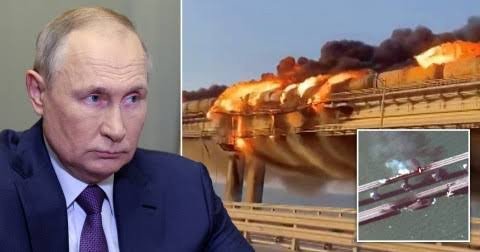
Russia's Federal Security Service (FSB) has detained five Russians and three citizens of Ukraine and Armenia in connection with the bombing of the only bridge that connects mainland Russia to the annexes Ukranian region of Crimea, an attack Russia said was masterminded by Ukraine. Ukraine has not officially confirmed its involvement in the bridge blast on Saturday, but some Ukrainian officials have celebrated the damage and an unidentified Ukrainian official told the New York Times that Kyiv was behind the attack. The FSB said the attack was organised by Ukrainian military intelligence and its director, Kyrylo Budanov adding to accusations by Russian President Vladimir Putin over what he has called a "terrorist attack" against critical civilian infrastructure. Russia arrests 5 Russians and 3 others over Crimea bridge bomb blast, after blaming Ukraine for attack "The organizer of the terrorist attack on the Crimean Bridge was the Main Intelligence Directorate of the Ministry of Defense of Ukraine, its head Kyrylo Budanov, its employees and agents," said the FSB on Wednesday, October 12. The FSB said the explosive device was camouflaged in rolls of construction polyethylene film on 22 pallets with a total weight of 22.7 tonnes, and moved from Ukraine to Russia via Bulgaria, Georgia and Armenia. "Control over the movement of the cargo along the entire route and contacts with participants in the criminal transportation scheme were carried out by an employee of HUR MO," the FSB said in a statement, using the acronym for Ukrainian military intelligence. The 12-mile (19 km) road and rail bridge, a project personally opened by Putin in 2018, had become logistically vital to his military campaign, with supplies to Russian troops fighting in south Ukraine channelled through it. The explosion wrecked one section of the road bridge, temporarily halting traffic. It also destroyed several fuel tankers on a train heading towards the annexed Crimean peninsula from neighbouring southern Russia.

In the months preceding the invasion, Russian officials accused Ukraine of Russophobia, inciting tensions, and repressing Russian speakers in Ukraine. They also made multiple security demands of Ukraine, NATO, and non-NATO allies in the EU. Commentators and Western officials described these as attempts to justify war.

The invasion began on the morning of 24 February, when Russian president Vladimir Putin announced a “special military operation” for the “demilitarisation and denazification” of Ukraine.

In his address, Putin espoused irredentist views, challenged Ukraine’s right to statehood, and falsely claimed Ukraine was governed by neo-Nazis who persecuted the ethnic Russian minority.
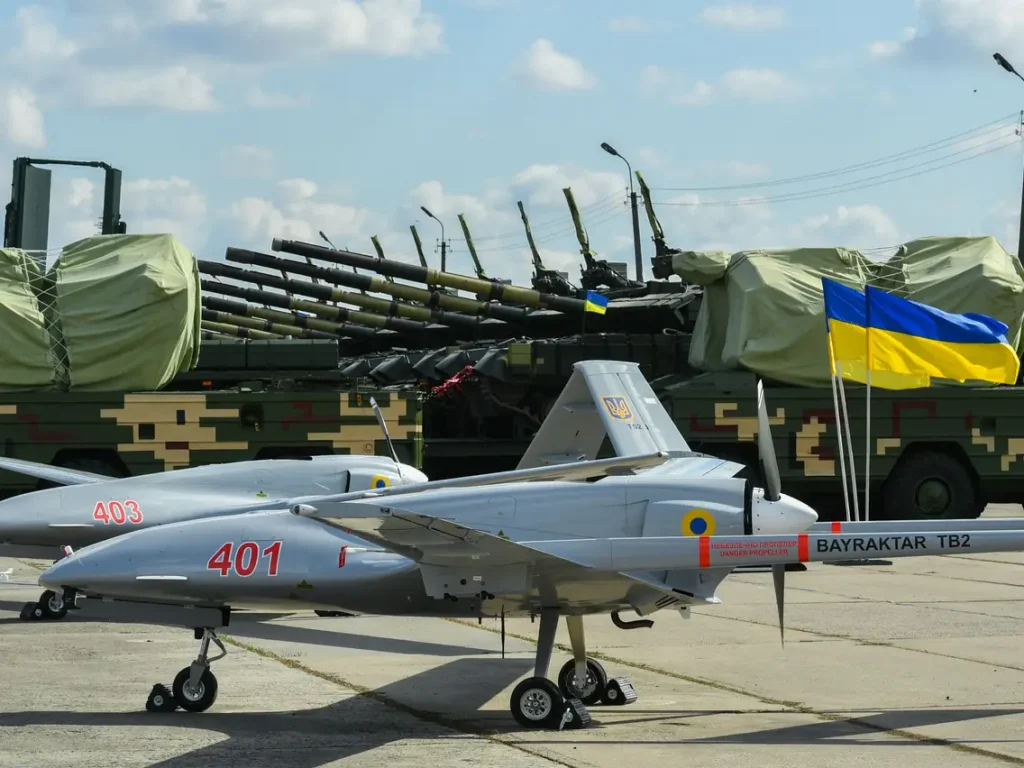
Minutes later, missiles, rockets and airstrikes hit across Ukraine, including the capital Kyiv, followed by a large ground invasion from multiple directions. Ukrainian president Volodymyr Zelenskyy enacted martial law and a general mobilisation.

Russian attacks were initially launched on a northern front from Belarus towards Kyiv, a north-eastern front towards Kharkiv, a southern front from Crimea, and a south-eastern front from Luhansk and Donetsk.

Russia’s advance towards Kyiv stalled in March, with Russian troops retreating from the northern front by April. On the southern and south-eastern fronts, Russia captured Kherson in March and then Mariupol in May after a siege.

– Russia militants

On 19 April, Russia launched a renewed attack on the Donbas region, with Luhansk Oblast fully captured by July 3. Russian forces continued to bomb both military and civilian targets far from the frontline. Ukrainian forces launched counteroffensives in the south in August, and in the northeast in September.

Soon after, Russia announced the annexation of partially occupied southeastern Ukraine as the conflict rises.
Previous articleVictoria Beckham quells divorce speculations as she explains why she removed David Beckham tattoo
Next articleWhat is the difference between Belarusian and Russian Cyrillic script
Ola Alabi
Ola Moses is a certified writer, He writes technically and creatively. He is the CEO of WORDSWORTH, a house where writing is made easier for all. He is a content creator at EsB TV, since 2019. He is a young man that showcases professionalism in all that he does, he was announced as Child and Green Foundation Person of the Year 2018, one of his many lists of honours.

LEAVE A REPLY

Please enter your comment!
Please enter your name here